‹ BackNewsMachine learning

Machine learning

Transformer
2026-10-12 04:20:34

BUPT team’s MiTA reframes efficient attention through a fast-weight FFN lens

A research team from Beijing University of Posts and Telecommunications has introduced Mixture-of-Top-k Attention, or MiTA, a method that recasts standard attention as a feed-forward network whose weights are generated by the current input and whose hidden width grows with sequence length. The paper, accepted to NeurIPS 2026, uses that fast-weight view to build a five-dimensional taxonomy for efficient attention and then proposes a design that combines reusable routed experts with a shared global expert. In the paper’s formulation, efficient attention methods fall into two broad paths: compression, which summarizes a growing fast-weight network into compact modules, and routing, which preserves raw content but only visits selected parts. MiTA tries to bridge the two. It extracts a small set of landmark queries, lets them build Top-k routed experts from the full context, and also uses the same landmarks to construct a shared global representation. Each query then reuses an expert rather than assembling its own private Top-k set. The reported results cover ImageNet-1K classification, ADE20K segmentation, Long Range Arena, and arXiv long-document classification. The paper says MiTA reaches 79.8% Top-1 on DeiT-S versus 79.9% for full attention while cutting FLOPs from 4.6G to 4.4G, reduces total LRA training time from 10.6 hours to 2.4 hours, and posts 88.0%, 92.9%, and 98.7% accuracy on arXiv classification at 16K, 32K, and 64K lengths.

280
BUPT team’s MiTA reframes efficient attention through a fast-weight FFN lens
Apple study says lean AI agents can match or beat multi-agent systems
NMR briefly hits 17.58 USDT, up 41.73% in 15 minutes
TouchScale
2026-10-08 23:43:38

TouchScale releases 500-hour vision-touch dataset, lifting robot task success from 22.5% to 57.5%

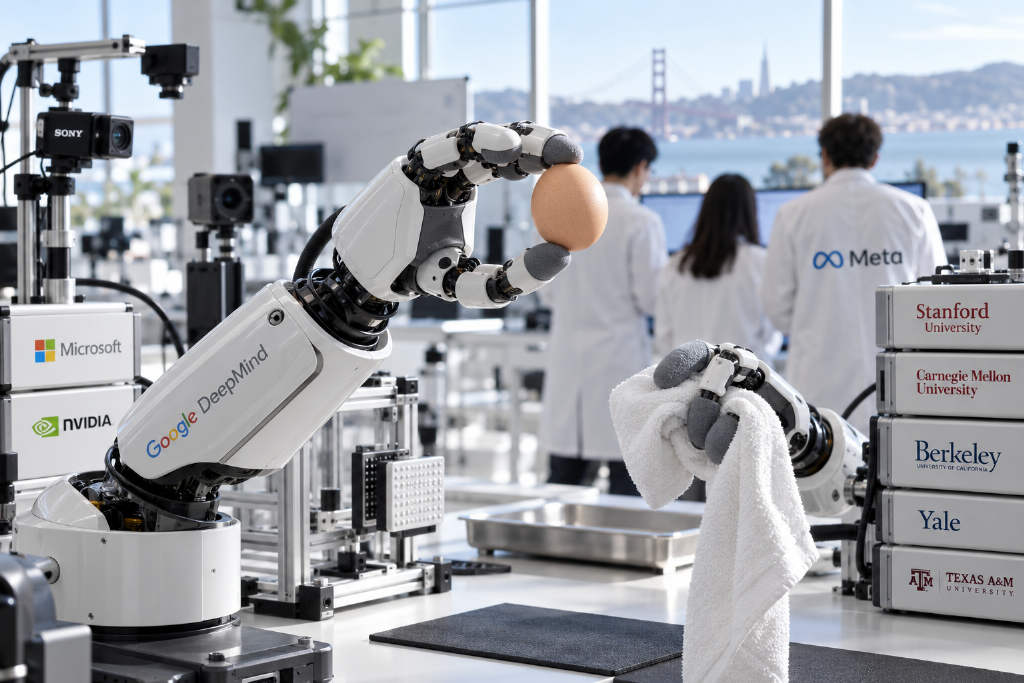
Researchers from 15 institutions, including Texas A&M University, Google DeepMind, Carnegie Mellon University, Stanford University, the University of California, Berkeley, Yale University, Microsoft, NVIDIA, Meta, and others, have introduced TouchScale, a 500-hour human vision-touch dataset collected with a single sensor stack and a unified capture and synchronization pipeline. The project is designed to test whether visual-tactile learning shows the same scaling gains seen in large video datasets when data quality and hardware consistency are held constant. The dataset includes synchronized head-mounted RGB-D, wrist RGB video, and full-hand tactile signals from gloves with 880 taxels per hand. It spans about 87,000 interaction recordings, roughly 2,000 task descriptions, more than 1,500 objects, nine environment categories, over 800 scene configurations, and around 20 data collectors. In experiments, TouchScale improved zero-shot cross-sensor tactile prediction and also produced the best visual encoder accuracy across MECCANO, Something-Something V2, and Ego-Exo4D when tactile signals were used as supervision. In real-world robot tests with an xArm6 and a BrainCo Revo 2 hand, adding TouchScale mid-training before post-training raised the average success rate across four contact-heavy tasks from 22.5% to 57.5%, without using human action labels or mapping human hand motions to robot actions.


290
TouchScale releases 500-hour vision-touch dataset, lifting robot task success from 22.5% to 57.5%
Runway
2026-10-01 14:30:53

Runway says Praxis-1 brings internet video pretraining to robots with results close to specialist datasets

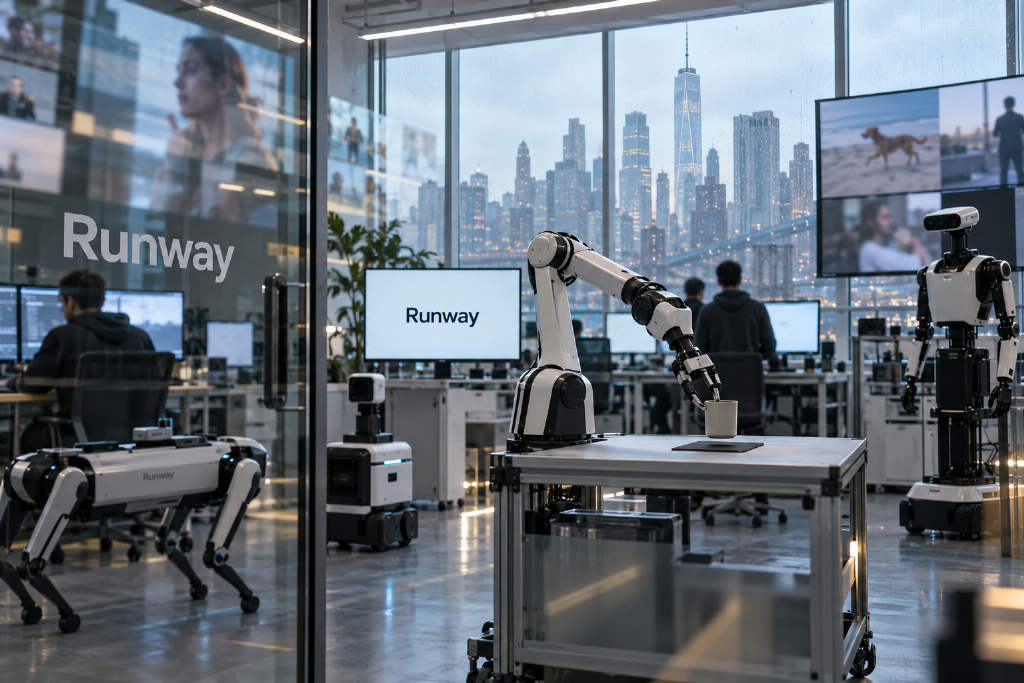
Runway has introduced Praxis-1, a robotics model that applies techniques developed for AI video training to real-world robots. The system learns from large volumes of ordinary internet video, using those clips to model how objects move and how people complete tasks, then converts that knowledge into robot actions. In an object placement test, Runway said robots pretrained on internet video posted an average error of 16.1 centimeters. When trained instead on specially collected robot teleoperation video, the average error was 16.0 centimeters. The company said the benchmark covered 93 evaluations, with the two training approaches finishing nearly even. Runway argued that if this approach scales, the amount of usable training data for robotics could expand by orders of magnitude, since teleoperated robot data requires hardware, physical space, and human labor, while ordinary video is already abundant online. Praxis-1 has been tested on multiple robots from Noble Machines, Standard Bots, and Ultra, including robotic arms, dual-arm systems, and mobile robots. The company also showed the same policy continuing a task after moving from a studio setting to a kitchen. Praxis-1 is currently available only through an early access application, while model weights are planned for release in the coming months. Parameter count and fuller independent evaluations have not yet been disclosed.

380
Runway says Praxis-1 brings internet video pretraining to robots with results close to specialist datasets
NVIDIA launches Kumo Tabular, a tabular foundation model that predicts new rows in one forward pass
NVIDIA opens applications for its 2027-2028 graduate fellowship program
McDonald’s uses AI pricing engine to adjust menu prices by willingness to pay